


Making Room for the Unexpected

RHANA PANHUIS > Multi-disciplinary Artist, Ceramics, Painting & Jewellery from Snells Beach
How experimentation, creative challenges
and a willingness to let go opened up new possibilities in Rhana's art practice.

I’ve had a big change in my art practice lately.
It’s not foreign to me to explore. As an artist, I need to ponder, touch, make marks, tear, experiment with new things, explore different mediums and materials, and let go of being in full control. Getting too “tight and safe” can hinder us from taking risks and experiencing those delightful “happy accidents” that can enrich our art practice enormously.
For me, this might mean going for a walk, collecting colours from nature, writing fresh thoughts in a sketchbook, taking photos, and documenting, documenting, documenting!
This creates precious space to keep our curiosity alive and ask: What am I trying to say? What emotion am I expressing? What conversation do I want to leave with the viewer?
1. What was pushing me through?

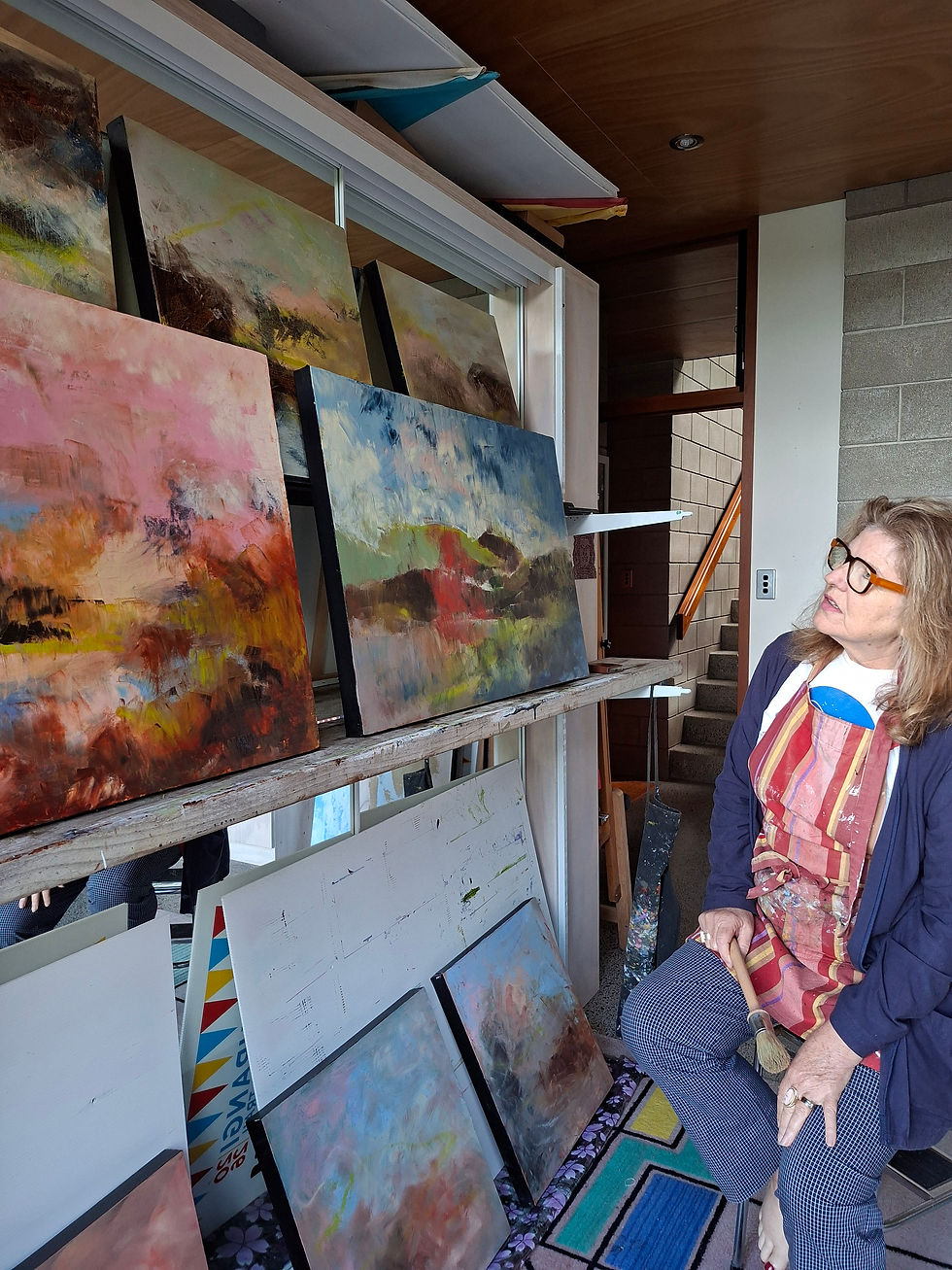
Time constraints and the need to make sellable art often meant creating smaller works that didn’t always embody the depth and richness I wanted to explore. What helped me change direction was a fellow artist, art teacher, and gallery owner, Hilary Austin. We have supported each other’s work, creative processes, and gallery. Her themed exhibitions provided a wonderful structure for exploration, with deadlines and briefs to respond to. Think of the 30 × 30 show, for example. I think we took part in around ten exhibitions during her time at the gallery. Each one inspired new ideas and helped bring a sense of cohesion to the shows. One of the most powerful was a recent invitation to upscale or downscale. We had to take an original work from our past and create one or two new versions at a different scale. I chose a mixed-media piece and decided to go from a 15 × 15 cm work to two larger pieces, the biggest measuring 122 × 122 cm! It
was scary, powerful, and thoroughly enjoyable. The entire process changed my perspective and deepened my love for my materials.
2. Did the change feel forced?

Not at all! I felt gently challenged, and I accepted it because I loooove a challenge! I had dreamed of working bigger but couldn’t quite take the leap without the right kind of nudge.
3. What was the hardest part about bringing a body of work to an end?
I like to give my work time to sit in my living room. Often, I’ll notice things that annoy me, areas that need resolving, or ideas for new work. Having the work around also invites input from family and friends, which can be valuable.
4. Did I keep any materials or habits from my previous practice?
Yes! My very personal relationship with paper has only strengthened. I’m also learning so much compositionally. Painting is teaching me about light and dark, tonal shifts, choosing shapes, and editing my work.
5. How did I approach finishing, and were there any gaps?
Health and life sometimes get in the way, so I’ve had to surrender to my energy levels and focus on what I can create with joy, rather than pushing myself. We are constantly responding to relationships, challenges, and life experiences. These all keep us thinking about our work and help strengthen what matters most to us in our practice. Then, one random day, something shifts. I go into my studio, clean up, smell the art supplies, and begin again.
6. Has this changed my identity as an artist?
Yesss! Working bigger was something important to me. We all have fears about filling a large space, but as our relationship with our materials grows and strengthens, so does our confidence. When something isn’t working, we develop the skills to find our way back towards a place of resolution and contentment with the work.
7. What has influenced this change?
So many things! My family dynamics, health, love of the landscape, and sensitive relationship with horses have always informed my work. Bringing the figure into my art is also about being present. Through illness and stress, I sometimes felt as though I had left the building! My work gives me a way to reconnect with myself and what I’m experiencing.
8. What would I tell my younger self?
We are right where we need to be. As life shapes our experiences, we develop an authentic self and discover the conversations we want to have through our work. Understanding why we create and how we feel is so important. Without the contrast of struggle, we wouldn’t know bliss. We are never far from content for our work; we just need the tools to guide the process. If we stay dedicated and curious, the ideas will flow.

9. What excites me that I couldn’t have predicted?
That I would love working big and now want an old factory so I can go REALLY BIG! Of course, that means generating income for much bigger materials!
10. What would I say to another artist?
Talk to me anytime! I’m passionate about people who genuinely want to explore their potential. I approach my work with horses and horsemanship in much the same way. Perhaps we could even develop workshops together around this very idea. The possibilities are endless! But if I could leave you with one practical takeaway, it would be this:
Make sketchbooks your constant companion.
Work quickly and regularly until the pages become an extension of you. Document sayings, colours, thoughts, ideas, photographs, and anything that feels special to you. Record what you notice and what you think about.
Have doodle days dedicated to expressive mark-making, allowing yourself to loosen up and experiment without worrying about the outcome.
And mind maps? A game changer!
These are all tools that art school instils in us, and they can be invaluable in keeping our creative practice alive.


header.all-comments