


The Creative Journey: New Artists, New Ideas & the Joy of Making


There is no single way to become an artist.
For some, creativity begins in childhood and never really leaves. For others, it is something rediscovered later in life. Some artists begin with a carefully considered idea; others put their hands to the material and see what happens. Some are drawn to colour, pattern and abstraction, while others find inspiration in the history held within an old piece of paper or the traditions of Japanese pottery.
What connects them is the desire to keep making.

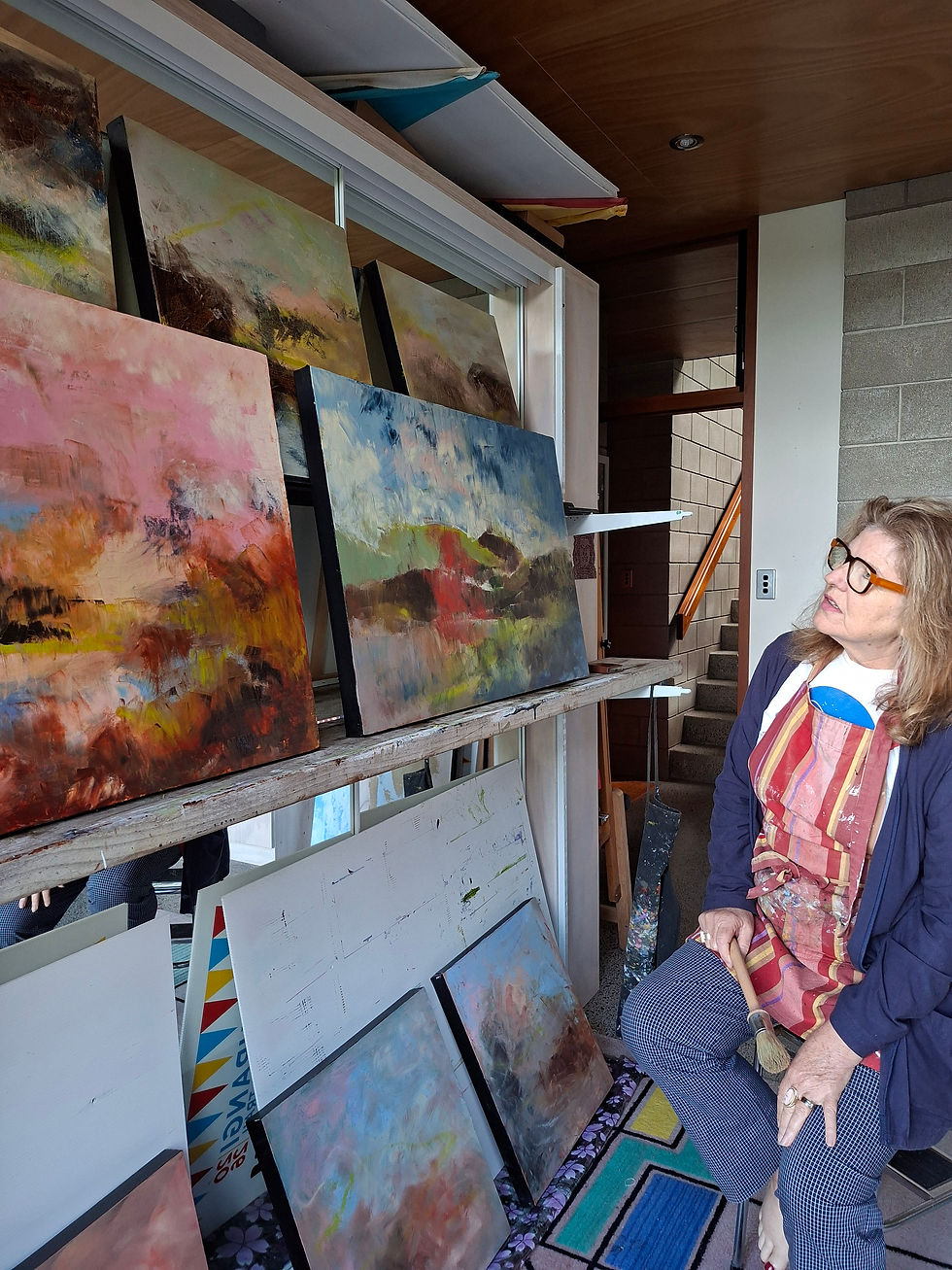
For Dianne Wyatt, that desire goes back to her earliest memories of sketching with her father. Today, the acrylic painter deliberately begins without a plan, allowing each painting to evolve intuitively. She is continually trying to become more abstract, striving for that “illusive painting that feels like a song.”
For Dianne, there is something almost essential about the daily act of creating. “Creating art is my therapy,” she says. “Every day is a painting day.”
That idea of art as an instinctive part of life resonates with Clare Woods, who says she can't remember a time when she wasn't creating. Coming from a creative family, making has always been part of her world.

Today Clare works primarily as a mixed-media collage artist, transforming recycled paper through printing, painting, cutting and reassembly. She is fascinated by what paper remembers — the traces of its previous life that remain beneath layers of colour and texture. “Every fragment has lived another life before becoming part of something new,” she says. Her description of her own work — “organised chaos, painterly geometry” — perhaps captures both sides of her practice:

the freedom of experimentation and the order needed to bring the fragments together.
For Lara Ashley, it is the possibilities of clay that keep that sense of discovery alive. Currently completing her diploma, she is drawn to the fact that there is always something new to try.
“I’m interested in playing with clay and what my endeavours produce,” she says, describing her artistic style simply as “evolving.” That willingness to experiment is at the heart of many creative practices.
Above: Lara Ashley
For potter Theo Leach, making has always been more important than the idea of being an artist. His work is a creative release and a record of his journey of learning, with spontaneity playing a central role.
Above: Theo Leach
There is freedom in forming clay on the wheel and then carrying that expression into the glazing and finishing process. Theo's interest in Japanese pottery techniques and wabi-sabi sits alongside an enduring fascination with abstract expressionism. Perhaps unsurprisingly, the thing that has surprised him most is just how endless the learning can be — and how enjoyable and rewarding that journey is.
Above: Samantha Freeman
For Samantha Freeman, the process is equally important. Working across painting, ceramics, yarn and textiles, Samantha describes her practice as abstract and colour driven, with interests ranging from colour theory and dynamic symmetry to collage and pattern. “My work is as much about the process as it is the final product,” she says.
Above: Amy Prebble
For some artists, however, the process is also about discovering that the ideas that matter most may be remarkably persistent. Amy Prebble has been surprised to find that some of the concepts she is drawn to never really change, despite the constant cycles of “remembering, forgetting, and being inspired.”
Perhaps this is one of the less visible aspects of an artistic practice. Artists may change mediums, techniques and directions, but certain ideas can continue to surface, asking to be explored again. For oil painter Bonnie Selak (see cover photo), those recurring ideas are filled with magic, symbolism and emotion. Her work explores representational and impressionistic painting alongside fantasy, with fairies, women, flowers, forests, nature and quirky buildings all appearing within a world concerned with feeling and connection.
Bonnie's love of painting began when she was nine, when her mother enrolled her in after-school watercolour classes. That early experience gave her confidence, and although she pursued other things over the years, she kept coming back to painting.
A year ago, she decided to “go all in” on her art career because, quite simply, “it is so fun.”
Since then, the journey has accelerated. Bonnie has recently returned from Florence and Tuscany, where she completed a traditional Florentine art class and a plein air session overlooking the Tuscan hills. And this September she will travel to California for six weeks of study at Watts Atelier of Fine Arts. It is a dream come true — but perhaps the most important lesson Bonnie has discovered along the way is less about technique and more about mindset.
“It’s all about believing in yourself.”
That courage to step beyond what is familiar is echoed by Clare, who describes the creative journey as something that can make her feel “terrified and fantastic in equal measure.”
It is an apt description of creativity itself. To make something new requires a willingness not to know exactly where you are going. For Lara, creating art is “a fulfilling continuous experience.” For Theo, it is an endless journey of learning. For Dianne, it is therapy and a daily necessity. For Clare, it is non-negotiable. For Samantha, the process matters as much as the final work. And for Bonnie, it is a dream she has decided to pursue wholeheartedly.
Perhaps the most exciting thing about welcoming new members to the Mahurangi Artist Network is that none of these journeys are finished. They are evolving. There are new techniques to learn, ideas to revisit, materials to experiment with, exhibitions to pursue and unexpected directions waiting around the corner. And now, as these artists become part of the Mahurangi creative community, we get to see where their journeys take them next.


header.all-comments