


What's on the Easel? The Journey between Idea and Artwork


One of the great myths about art is that artists begin with a clear vision and simply work towards a finished result. In reality, most artworks emerge through a series of questions, experiments, setbacks, discoveries and decisions. Whether working in paint, glass, fibre, clay or mixed media, artists continually navigate uncertainty, searching for solutions while remaining open to unexpected possibilities.
The diversity of disciplines within the Mahurangi Artist Network highlights this beautifully. While the materials may differ, the creative challenges are often remarkably similar. Every artis must find a way through moments of doubt, technical obstacles, changing ideas, and the delicate balance between planning and intuition.
For glass artist Sandy Smith, a simple customer brief - "I want you to make me a fish, preferably a snapper' - became a journey of problem-solving and adaptation. Her stained-glass work, "The Lost Snapper", began with a vision of a fish swimming through a coral reef, despite the fact that snapper don't naturally inhabit coral reefs. Artistic licence was granted.
What followed was months of pattern adjustments, intricate cutting, layout changes, and the painstaking challenge of working with tiny pieces of textured glass. Some cuts failed. Others broke unexpectedly. Textured surfaces caused the cutter to skip. A fish eye had to be sourced from overseas. Each obstacle required a new solution.


First Step - the initial drafting of the pattern and making any adjustments and numbering the pattern pieces.
Teeny glass pieces are tough to work with so Sandy had a celebratory fist pump once these were cut.
Now for the simpler cuts - the blue tape holds all pieces in place.
Final cut and layout adjustments.
Foiling this many pieces without any coppy tape oxidation is challenging.
Now for the Snapper - Sandy has only 1 piece of glass available to cut specific bits for each part of the fish.
Attempting to get best use out of hard to cut textured glass. Sandy's cutter is jumping over the texture so its hard to get a clean cut.
After a few more struggles and broken bits, Sandy got there in the end. Now just waiting for the fish eye to arrive from a supplier in USA.
The fish eye is perfect! Sandy chose not to over analyse the end result too much as it was a complex commissioned artwork but in the end she was happy with the result.
Yet Sandy embraces these challenges as part of the appeal of her medium. "I've explored many creative mediums over the years, from sketchbooks to paintbrushes, but a blank canvas has always felt intimidating. Glass however, speaks a language that suits me. It blends creativity with structure, requiring thoughtful planning while offering endless opportunities to play with light, colour, opacity and texture."
Like many artists, Sandy's process began with a plan, but the work evolved through a series of responses to unforeseen challenges. The final piece may appear effortless to the viewer, but beneath the surface lies a story of persistence, adaptation, and countless creative decisions.
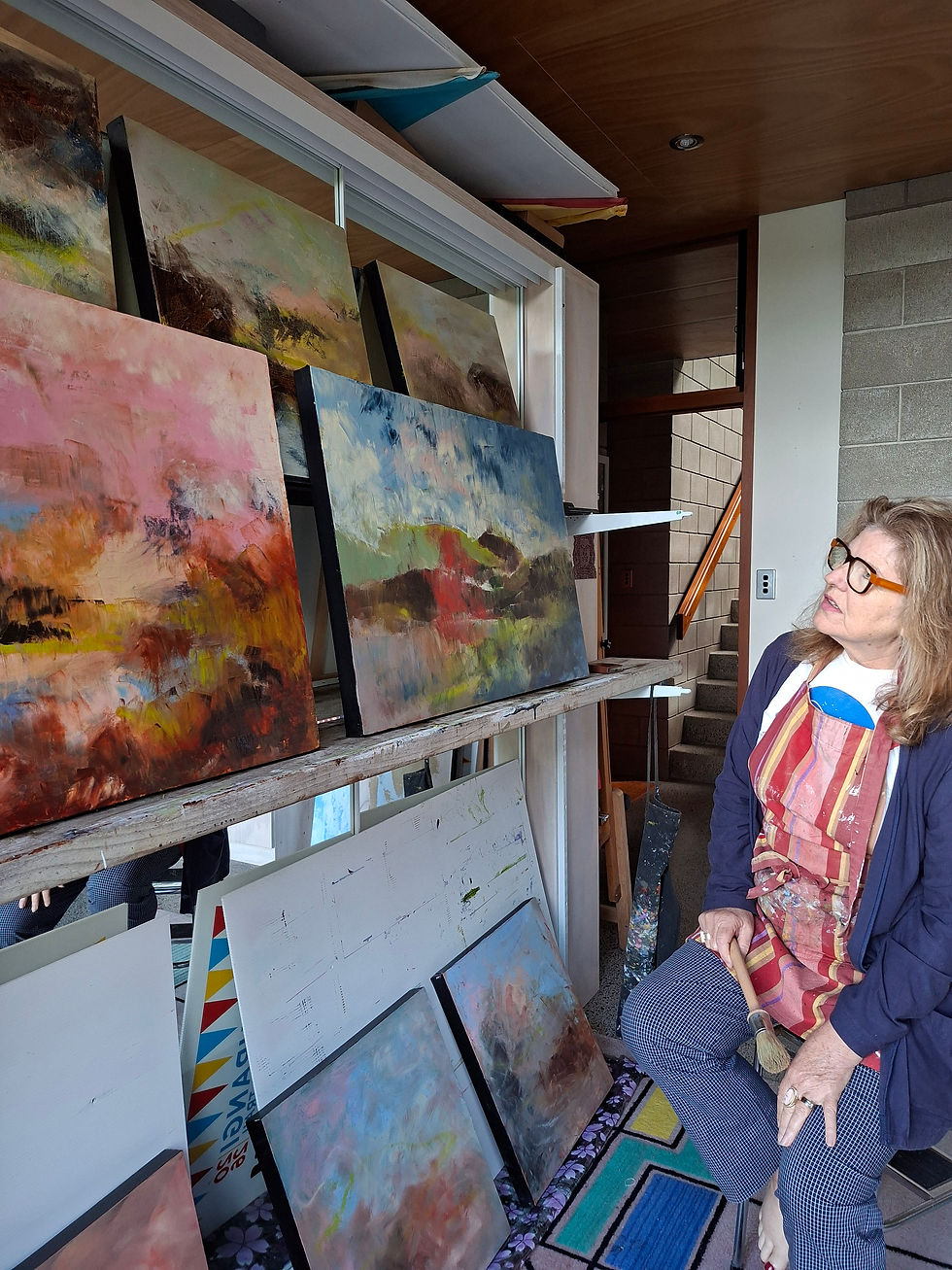
Painter Pam Dun's current body of work explores the changing moods of Kawau Bay, Martins Bay and the surrounding coastline. Her paintings begin long before brush touches canvas. Photographs, quick sketches, observations of changing weather, seasons, and light all become part of the creative foundation.
Working in both acrylic and oil paint, Pam starts with broad impressions rather than fixed outcomes. Colour choices become tools for conveying atmosphere: the warm intensity of a sunset, the muted quiet of an overcast day, or the subtle luminosity of early morning light.
The paintings remain in a state of flux for much of their creation. Layers are adjusted, colours reconsidered, and brushwork refined as the artist searches for the right balance between realism and abstraction.
The three works shared for this month's "What's on the Easel?" are not finished paintings but moments within that journey. They reveal something viewers rarely see - the uncertainty that exists between inspiration and completion. The challenge is not simply to record a landscape but to capture an experience, a mood, and a sense of place.

For mixed media artist Glenda Hopkins, 2026 has become a year dedicated to exploration itself. Inspired by Elizabeth Gilbert's words, "A creatively lived life is any life where you consistently choose the path of curiosity over the path of fear," Glenda has committed herself to stepping beyond certainty and embracing experimentation.

Her current project explores Agamographs - kinetic artworks that reveal different images as the viewer changes position. While the finished effect appears magical, the process is highly demanding. Metres of paper must first be carefully measured, marked, and folded with precision. Layers of gesso and paint are then applied before the painstaking work of building multiple images that will ultimately merge and transform as the viewer moves.
"The folding!" Glenda laughs. "hours of a two metre length measured, marked and folded."
The project is as much about courage as it is technique. Working with a new medium means accepting that outcomes are unknown, and that certainty cannot be guaranteed. As Elizabeth Gilbert writes in Big Magic, "Creativity asks you to enter into the realms of uncertain outcome, and fear hates uncertain outcome."
Glenda's willingness to embrace that uncertainty reflects something shared by all three artists featured here. Perhaps that is what makes art-making so compelling. The finshed work may be what we see hanging on a gallery wall, but the real story often lies in everything that happened before it arrived there. This month's "What's on the Easel?" reminds us that creativity is not about having all the answers. It is about remaining curious enough to keep asking the questions.
Click on link below to see Glenda Hopkins finalised work >


Comments