


When Creativity Takes a Different Turn

Sometimes an artistic journey takes an unexpected turn. We explore
what happens when artists change direction, let go of familiar ways of working,
and discover new possibilities in the process.
Have you ever felt the urge to change direction, even when you have spent years developing a particular way of working? Perhaps circumstances have changed, a familiar series has run its course, or a new idea keeps nudging you towards something different. For artists, these moments can be both unsettling and exhilarating. They can also open doors to discoveries we could never have anticipated.
For me, Karena de Pont, a painter and sculptor from Mahurangi West, the prospect of change has become very real. My artistic practice has always embraced several bodies of work at once, but now I'm contemplating a significant shift. My Burnt Offerings paintings, created on recycled charred cedar and transformed through my process of ‘painting with fire’, will continue. However, my popular Earth Sticks series, made from painted bamboo poles installed in gardens, is approaching its natural conclusion.
Earth Sticks has been a wonderfully satisfying part of my practice, but the physical demands of preparing the bamboo, the lengthy drying process and the practicalities of producing and installing the works have all played a part in my decision to move on. There is a sense of loss in saying goodbye to a series I have loved, particularly the freedom and enjoyment of painting each individual pole. Yet there is also an opportunity to rediscover something that has been waiting patiently in the background.
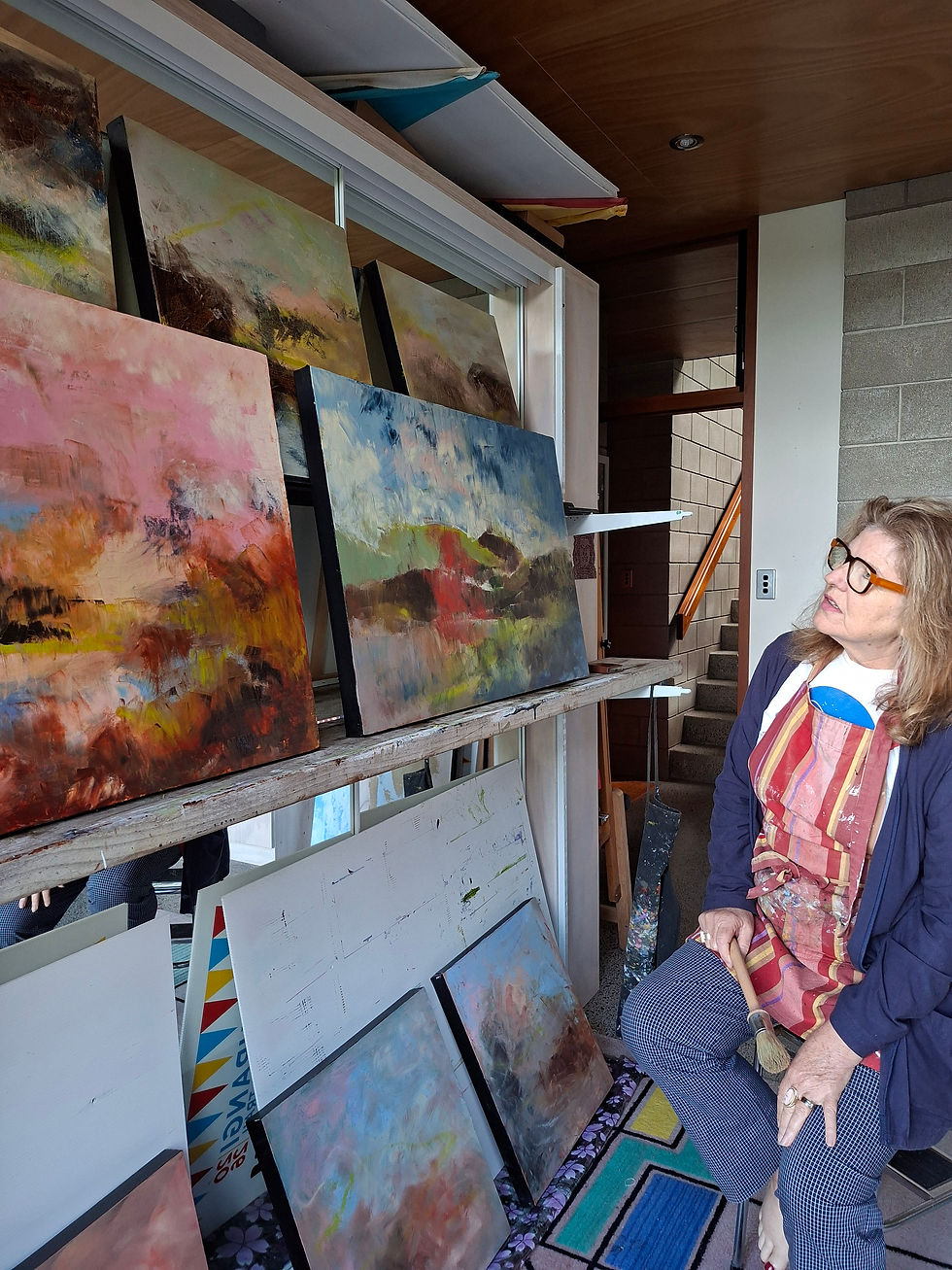
I've returned to my small downstairs studio, unearthed old stretched canvas panels and pulled out my oil paints. I am drawn to the familiar landscape and seascape of Opahi Bay, where I have lived all my life. Even views I have known for d
ecades continue to surprise me with their changing light, shifting colours and moods.
Rather than trying to reproduce the scenery, I want to create what I think of as ‘feelscapes’ — paintings that capture my emotional response to a particular moment. It feels like a new chapter, although not an entirely new beginning. Alongside the oils, I'm planning to explore Gelli printing and revisit earlier abstract series. There is plenty to discover, and I don't yet know where it will lead.
It seems I'm not alone in finding that a change of direction can bring unexpected rewards.
Sometimes all it takes is a nudge
For Rhana Panhuis, a multidisciplinary artist from Snells Beach working across ceramics, painting and jewellery, the turning point came through an invitation to experiment with scale. Having often worked on smaller pieces because of time constraints and the need to create work that could sell, Rhana had dreamed of working bigger but needed the right opportunity to take the leap.
Being challenged to upscale by her mentor, Hilary Austen has helped Rhana Panhuis develop and enriched her art practice. "It was scary, powerful, and thoroughly enjoyable". Right: The original 15x15 artwork that Rhana used to upscale.
A themed exhibition invited artists to revisit an earlier work and reinterpret it at a different scale. Rhana chose a mixed-media piece originally measuring just 15 × 15 cm and developed it into two new works, the largest measuring 122 × 122 cm. “It was scary, powerful, and thoroughly enjoyable,” she recalls. The experience changed her perspective and deepened her relationship with her materials. What began as a challenge became a discovery of just how much she enjoyed working on a larger scale. Now, her ambitions have grown further still: she dreams of finding an old factory where she can work REALLY BIG!
Rhana's experience is a reminder that sometimes we don't need to know exactly where a change will take us. We simply need an opportunity — and the willingness to accept it. As she puts it, “Getting too ‘tight and safe’ can hinder us from taking risks and experiencing those delightful ‘happy accidents’ that can enrich our art practice enormously.”
When life changes, art can offer a way forward
For Kerry Cline of Snells Beach, a change in artistic direction came during a difficult period in her life. Following the death of her husband, she experienced unwanted side effects from medication and decided to try painting on silk, a medium she had always liked.
What might have started as a practical change became something she genuinely enjoyed. Kerry's story is a reminder that creativity can offer a different focus when life takes an unexpected turn.
Her artistic journey has also taken her well beyond New Zealand. While living in Alaska, she painted local scenes, including the Northern Lights, and taught people in a maximum-security prison how to paint stylish graffiti. Today, back in New Zealand, she paints the scenery around her and teaches both children and adults the art of silk painting.
Although her materials and subjects have changed, teaching has remained a constant throughout her life. “Sometimes, stepping away from one thing helps you discover another,” Kerry says.
It is a simple observation, but one that speaks to the value of giving ourselves permission to explore something different rather than forcing ourselves to continue along a familiar path.
Keeping the essence, changing the approach
Not every pivot involves leaving a medium behind. Sometimes the change happens within the work itself, as an artist begins to question established habits and explore different ways of expressing an idea.
Matakana abstract painter and sculptor Tony White has spent the past year rethinking his approach to painting. Abstraction remains at the heart of his practice, but his technique is evolving. He is moving away from the horizontal, wet-on-wet process he used for years, which relied on random outcomes, towards a more deliberate, upright way of working.
His newer paintings use broader strokes and rhythmic adjustments to build depth and dimension. The change is not about abandoning abstraction, but discovering new possibilities within it. Tony describes the shift as “a more upright, deliberate application”. It is an example of how an artist can retain the essence of a practice while allowing technique, confidence and curiosity to move it forward.
Tony White has moved from wet on wet process (above left) to using bold, broader brush strokes (above right).
For Michelle Hales, the jeweller behind Two Plums Design in Point Wells, change has become an integral part of the creative process. Rather than seeing a pivot as a dramatic, once-in-a-lifetime event, she recognises that different stages of a practice can feed into one another. “Parts of the former practice always follow me into the new direction,” she explains. “And sometimes, a practice I pivoted away from returns with vengeance years later!”
Michelle's experience challenges the idea that every new direction must mean a permanent farewell to the old. Ideas, techniques and materials can lie dormant for years before finding their way back into our work, enriched by everything we have explored in the meantime.
Looking again at the things we think we know
For other artists, a change in direction can involve looking more closely at the world around them, or discovering new meaning in the materials they already have.

Matakana potter and mixed-media artist Brendan Adams has been exploring the histories hidden within landscapes and everyday objects. His exhibition Veiled Landscapes brings together ceramics, wood, steel and brass, allowing each material to contribute its own character rather than simply serve as a support for an idea.
Some of the timber in his work was salvaged from beneath a house that had been in his family for more than a century. Objects he had kept for years, waiting for the right opportunity to use them, have found new purpose in his work. Reflecting on these connections, Brendan asks us to consider “what stories and memories they carry, even when those stories aren’t immediately visible”.
His exploration suggests that changing direction need not always mean searching for something entirely new. Sometimes it means looking again at what we already possess, recognising its potential and discovering a different story within it.
Finding the confidence to begin again
Across these different artistic journeys, there is a common thread: change rarely happens in isolation. Our surroundings, relationships, experiences and changing circumstances all influence what we make and how we make it. Sometimes the next step is carefully planned; sometimes it arrives through an invitation, a challenge or an unexpected moment of inspiration.
For Rhana, working larger has helped her build confidence in her own abilities. She recognises that the more deeply we understand our materials, the better equipped we become to work through difficulties and find resolutions when something isn't going as planned. She also acknowledges that health and life can interrupt the creative process. Rather than continually pushing herself, she has learned to work with her available energy and focus on what she can create with joy.
Her advice to other artists is to remain curious, keep sketchbooks close at hand, document ideas and observations, and make time for playful experimentation without worrying about the outcome. “We are right where we need to be,” she says, reflecting on the way life shapes our experiences and helps us discover what we want to communicate through our work.
Perhaps that is the real lesson in all these stories. An artistic practice is not a fixed destination, nor does it need to follow a straight line. We can carry the best of what we have learned into new work, return to old passions, experiment with unfamiliar materials or simply change the way we approach something we have done for years.
For me, the prospect of returning to oil painting feels both familiar and new. I don't know yet whether the work will develop as I imagine, or what other discoveries might emerge along the way. But perhaps that uncertainty is part of the attraction.
After all, an artistic journey is not just about the work we produce. It is also about the things we learn, the risks we take, and the possibilities we allow ourselves to explore.
And sometimes, the most exciting part is simply beginning again.


Comments